Teddy Boys – Britain's First Teenage Subculture
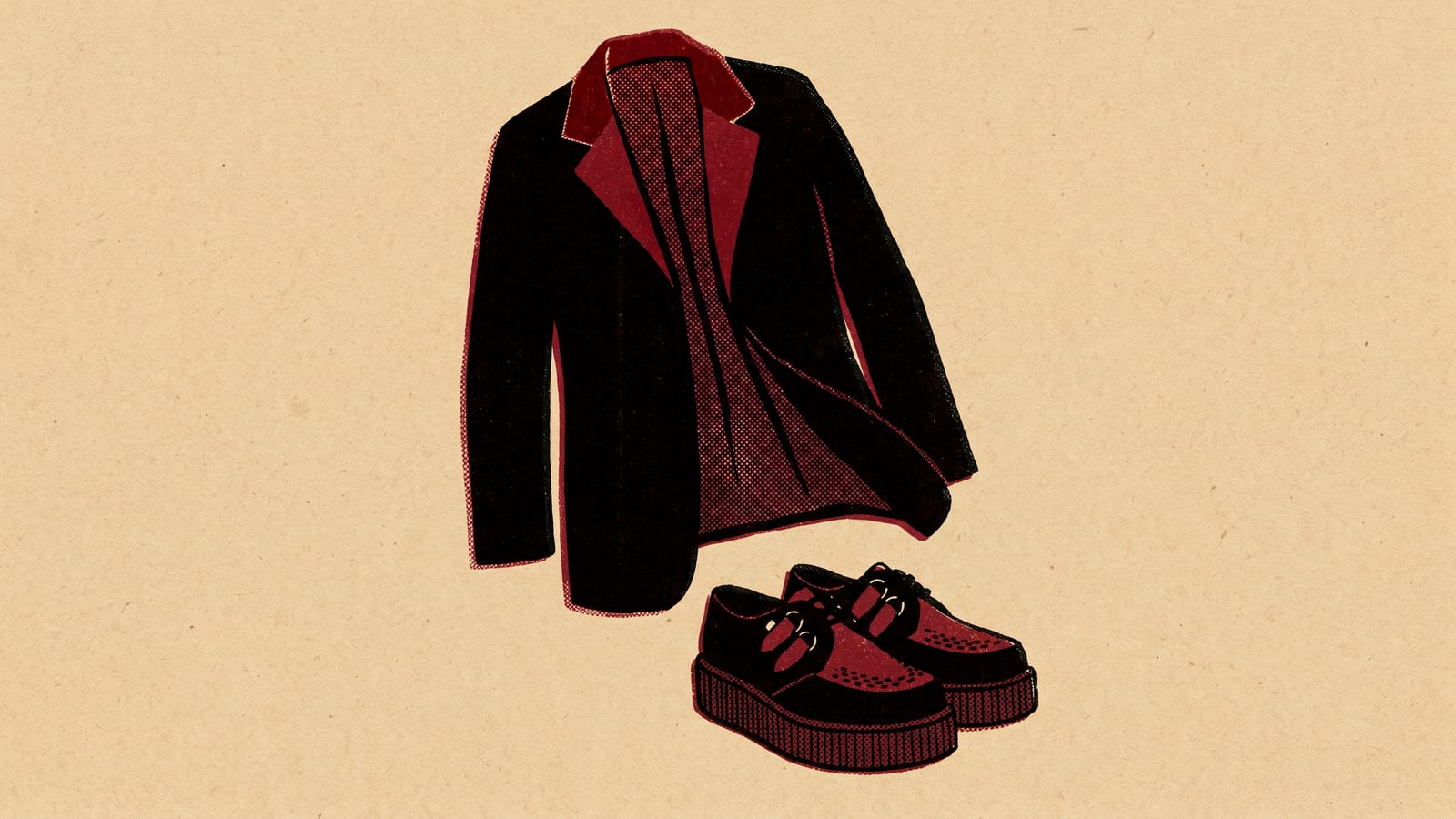
Before the mods, before the skinheads, before punk, there were the Teds. The Teddy Boy subculture is the starting point for almost every working-class British youth style that followed it, and it arrived not from some underground scene but from a Savile Row miscalculation.
The suit that nobody wanted
In the years just after the Second World War, a group of Savile Row tailors attempted to revive the long drape jacket and high-waisted tapered trouser of the Edwardian era. The target market was upper-class men who wanted to look as if the war had never happened. It did not work. The suits sat unsold and eventually drifted down to cheaper menswear shops in South London, where young working-class men found them and made them their own.
By the early 1950s a distinct look had crystallised: a long drape jacket, often in black or dark blue, with a velvet collar and pocket flaps; drainpipe trousers; a loose-collared white shirt with a slim “Bootlace” or “Slim Jim” tie; thick crepe-soled shoes, known as “brothel creepers.” The hair was swept into a quiff at the front and shaped into a “duck’s arse” at the back. The whole effect was sharp, considered, and unmistakably not for your parents.
A 1953 Daily Express article shortened “Edwardian” to “Teddy” and the name stuck.
Rock and roll and the cinema riots
The early Teds drifted between modern jazz, skiffle, and the more energetic end of what was being imported from America. Then rock and roll arrived, and the fit was obvious. Bill Haley’s “Rock Around the Clock” had already soundtracked the opening of the American film Blackboard Jungle when it played British cinemas in 1955. The following year, when Haley’s own concert film of the same title toured Britain, Teds tore up cinema seats, danced in the aisles, and started fights in the streets outside. Disturbances were reported at roughly 25 cinemas in September 1956 alone.
The press response turned this into the first great British youth moral panic. Newspapers ran headlines about “feral youth” and teenagers as a social menace. Parliament discussed banning the film. The Teds, who were mostly doing nothing more dangerous than dancing very loudly, became the symbol of postwar disorder. It is a pattern that would repeat, with different protagonists, for the next three decades.
Class and geography
The Ted was a working-class phenomenon from the start. South London, specifically areas like Elephant and Castle, was an early heartland, and the subculture spread quickly to other working-class districts in London and then outward to provincial towns. It was overwhelmingly male, though the Teddy Girls existed alongside the Teds from very early on and have been somewhat written out of the standard history.
The drape suit was an act of appropriation that ran both ways: working-class youth took a garment designed for toffs and made it theirs. The Teds were not trying to pass as upper-class; they were doing something more interesting, taking the look and charging it with a completely different energy.
The Notting Hill shadow
The subculture’s history has a serious stain. In August and September 1958, white mobs attacked the Caribbean community in Notting Hill. Teddy Boys were present in significant numbers and were directly implicated in the violence. It was not representative of the subculture as a whole, but it was real, and it embedded the Teds in the history of postwar British racism in a way that cannot be footnoted away.
The 1970s revival
The Teds never fully disappeared, but a proper revival gathered pace after the London Rock ‘n’ Roll Show at Wembley in 1972, which reunited several original American rock and roll acts before a large British audience. By the mid-1970s a new generation of Teds was on the streets, with louder jacket colours, more theatrical pompadours, and a self-conscious nostalgia for the 1950s original.
The revival Teds collided with punk almost immediately. In 1977, King’s Road in Chelsea saw regular skirmishes between Teds and punks. The hostility was mutual and sometimes physical. Over time, though, the edges blurred: elements of Ted style and attitude fed into the rockabilly and psychobilly scenes of the early 1980s, which owed as much to the drape jacket as to any guitar sound. The rockers occupied a parallel lane throughout, sharing the rock and roll loyalty but organised around motorbikes rather than tailoring.
Why it matters
The Teds established the template: a working-class youth subculture built around a specific, codified look, tied to a specific music, and received by the wider culture as a threat. Every subculture covered on this site is in some way a response to, or a development from, that model. The Teds showed that style could be an argument.